

A federal office created to investigate supplements’ health benefits is, in effect, telling us that supplements can’t really help us stay healthy. Its own scientific resources tell a more complicated story. Action Alert!
Listen to the audio version of this article:
THE TOPLINE
- NIH’s Office of Dietary Supplements has framed supplements the supplement debate around whether they can replace medications instead of examining their potential health benefits.
- Restrictions on supplement marketing claims do not establish what nutrients can or cannot do—and ODS’s own resources acknowledge important benefits.
- ANH’s lawsuit challenges FDA’s suppression of 114 government-backed nutrient–disease risk-reduction claims, seeking to give consumers access to truthful, appropriately qualified health information.
The government should not stack the deck against dietary supplements—especially through an office Congress created to investigate their benefits. Yet that is exactly what the Office of Dietary Supplements (ODS) at the National Institutes of Health does in a recent ODS Digest newsletter.
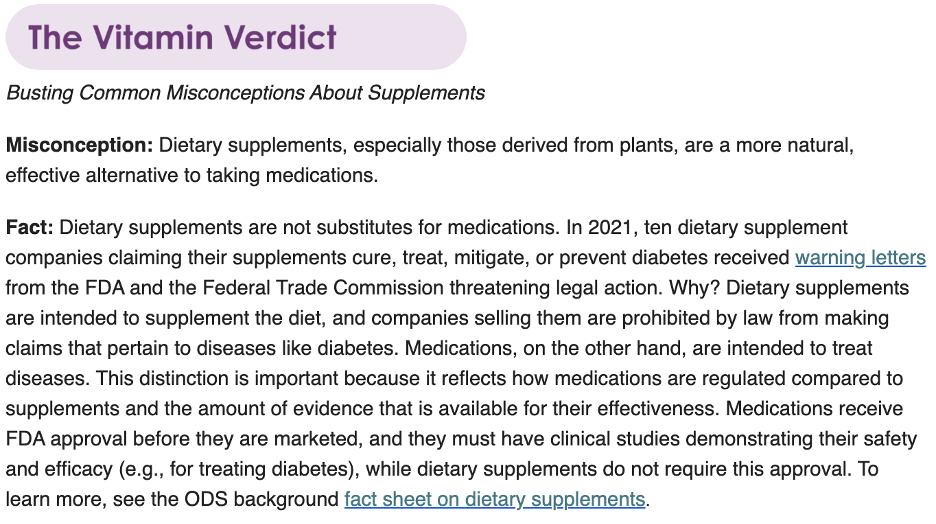
Under the banner “The Vitamin Verdict,” ODS frames the issue around whether supplements are a more natural, effective alternative to medications. That framing sets supplements up to fail. It sets up a straw man argument—that supplements can replace drugs—and knocks it down, sidestepping the questions consumers actually need answered: How do supplements affect the body? Which can help support our health, reduce disease risks, or help manage particular conditions? What does the evidence show?
With this mindset, it is no wonder our petition on opening the door to nutrient-disease claims based on government statements was denied, forcing us into our current lawsuit challenging the FDA decision.
ODS’s chosen framing invites dismissal of those important questions. It steers readers toward skepticism before any evidence about a particular supplement is even considered. For an office charged with exploring supplements’ contribution to health care, that is an extraordinary way to approach the subject.
Then comes the sleight of hand. Instead of examining research, ODS points to FDA and Federal Trade Commission warning letters against companies marketing supplements for diabetes. It explains that supplements cannot legally carry drug-treatment claims and do not undergo the same approval process as medications.
But a restriction on what a company may say is not proof of what a nutrient cannot do. Citing the law cannot settle whether a particular supplement has a scientifically supported benefit—especially when the laws have evolved over time to favor the drug industry.
This is precisely the divide ANH is fighting to close: the gulf between what research reveals about natural health products and what the government allows companies to tell consumers.
ODS’s Own Website Complicates Its Message
Remarkably, the ODS fact sheet linked in the email acknowledges that supplements can improve health and help manage some health conditions.
For example, it identifies folic acid’s role in reducing certain birth defects and explains that an AREDS combination of vitamins and other nutrients may slow further vision loss in people with age-related macular degeneration. It also recognizes that many other supplements require more research.
This is precisely why we filed our FDAMA lawsuit. The government makes hundreds of claims on its websites about the relationship of a nutrient to a disease based on findings from peer-reviewed science. The law says that, if the government makes such claims, supplement companies should be able to use them too so consumers can benefit. Yet in practice the FDA blocks them. We’re fighting to change that so you can be armed with the information to improve your health.
The Law Already Recognizes Food’s Role in Disease Management
There is another complication missing from this simple food-versus-drug story: medical foods.
Federal law recognizes specially formulated foods used under physician supervision for the dietary management of diseases or conditions involving distinctive nutritional requirements.
FDA itself gives phenylketonuria, an inherited metabolic disorder, as an example of a condition for which medical foods may be used.
Medical foods are not interchangeable with drugs or supplements. But their existence demonstrates that nutrition can play a recognized clinical role without following the drug-approval pathway.
Our laws already acknowledge this principle. Public health messaging should reflect it.
The Government’s Own Research Is at the Center of ANH’s Case
The disconnect between government science and government restrictions is precisely what ANH is challenging.
In developing this work, ANH initially compiled a databased with some 450 nutrient–disease relationships drawn from publicly-available government materials.
Our original petition sought access to 118 nutrient-disease claims. The subsequent litigation challenges FDA’s suppression of 114 nutrient–disease risk-reduction claims drawn from publications by federal health bodies, including NIH, ODS, and CDC.
ANH and its fellow plaintiffs filed a motion for summary judgment on September 16, 2026. We argue that FDA has unlawfully restricted the pathway Congress created under the Food and Drug Administration Modernization Act for claims based on authoritative government statements. The plaintiffs have also expressed willingness to use reasonable, accurate qualifications where needed.
The principle is straightforward: consumers should be able to encounter truthful, appropriately qualified information about nutrients when deciding what to buy—not only when searching government websites.
Give Americans the Evidence
ODS should help consumers distinguish between exaggerated promises and credible nutritional options. That means explaining benefits, uncertainties, risks, and interactions with the same care.
It also means distinguishing advice against unsupervised medication replacement from a much broader question: what role can nutrition and supplements play in preventing disease and improving care?
Americans deserve an answer grounded in research. They deserve a regulatory system that allows truthful findings to reach them. And they deserve a federal supplements office willing to fulfill the mission Congress assigned it.
If ODS wants to deliver a vitamin verdict, it should put the evidence before the public.
Support Our Lawsuit
This week, we filed our response opposing FDA’s Motion for Summary Judgment in our landmark FDAMA lawsuit. ANH-USA is the only health-freedom organization in the country directly challenging a regulatory monopoly—reinforced by the revolving door between Big Pharma and FDA—that effectively reserves disease-related claims for FDA-approved drugs, even when authoritative government science supports those same claims for nutrients and other natural products. Your support helps us carry this fight forward and defend every American’s right to access truthful, science-based health information.
Please consider donating to ANH now to support our landmark FDAMA lawsuit.