


By Chimnonso Onyekwelu LLB and Rob Verkerk PhD (edited by Michael Ames-Sikora)
Despite leading the world in natural health innovation, America spends trillions on a failing system while sidelining proven alternatives. Discover the six major factors—from regulatory capture to media manipulation—that keep natural therapies on the margins. It’s time to reclaim true health freedom.
Listen to the audio version of this article:
THE TOPLINE
- Despite massive healthcare spending producing poor health outcomes, entrenched special interests keep preventive, non-drug approaches marginalized in favor of pharmaceutical-driven care.
- ANH identifies six major forces constraining natural health, including regulatory control over health claims, financial and market incentives favoring drugs, strict definitions of “standard care,” media and information gatekeeping, weaponized law and regulations, and cultural conditioning toward symptom-based treatment.
- Meaningful reform requires addressing these structural forces simultaneously—expanding evidence standards, transparency, and consumer choice to integrate natural health into mainstream care rather than keeping it on the margins.
America is the R&D capital of natural health. The range of dietary supplements and other natural health products available on the US market dwarfs that in many other global markets, especially the European Union that has long used regulation as a tool to remove products that compete with drugs.
But anyone with keen eyes on the US market will recognize that the diversity of products on the US market has flatlined in recent years, especially when compared with the boom that followed the passage of the Dietary Supplement Health and Education Act of 1994 (DSHEA).
Why has innovation declined? Why has natural health not assumed its rightful place as the mainstay of health care, as distinct from disease management?
In this article, we investigate the intricate, multi-factorial manner by which special interests work to keep natural health at the margins of health care.
America’s health crisis
The United States spends more on healthcare than any country in the world by a wide margin. In 2024 alone, spending reached an estimated $5.3 trillion, about 18% of GDP, averaging over $15,000 per person. Yet despite this extraordinary investment, the US consistently ranks near the bottom of high-income nations for life expectancy, chronic disease burden, and preventable deaths. Put simply, the industrialized country that spends the most on healthcare is also the least healthy.
Prescription drugs are the go-to treatments for chronic disease, yet they’re also now recognized as the third leading cause of death in industrialized countries.
At the same time, research suggests up to 80% of chronic disease could be prevented or reduced through nutrition, lifestyle changes, supplements, and other low-cost interventions. So why aren’t these approaches central to care?
The answer lies in how our health system is structured. Health outcomes are shaped by who sets the rules, who controls the market, and who defines “misinformation.” When information is filtered and the role of foods and nutrients in prevention can’t be legally communicated, truly informed health choices become far more difficult.
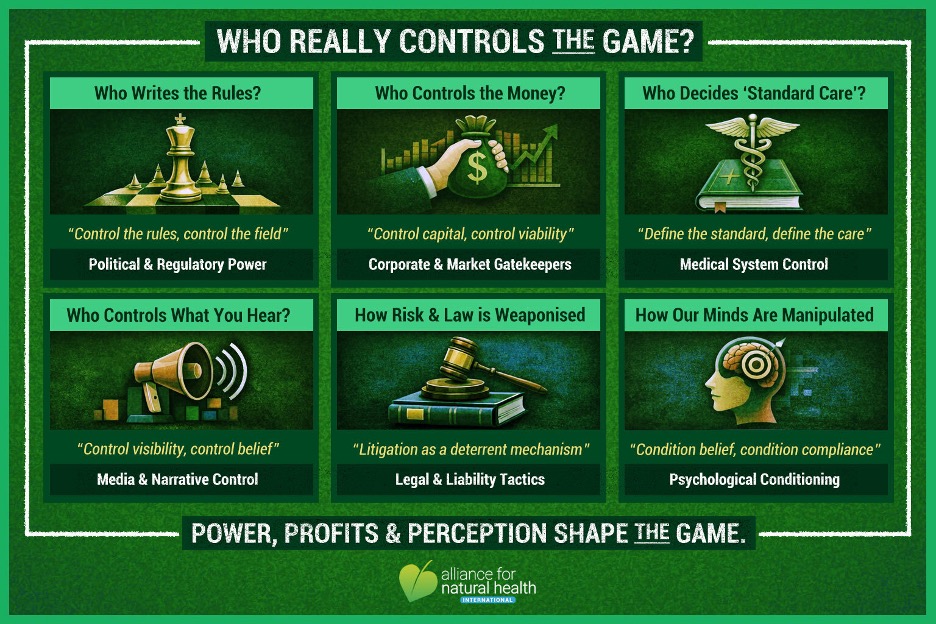
We pointed several AI engines at ANH’s library of information to come up with what the major obstacles to health freedom are. From a long laundry list of items, we’ve distilled it down to six interconnected macro-drivers that work to constrain natural health in the US.
The ‘Big 6’ Macro-Drivers Constraining Natural Health
1. Who Writes the Rules?
Beyond genetics, health is largely shaped by how and where we live, how we move, what we ingest and inhale, how we work and recreate, and other aspects of our behavior and choices. But choices, especially as they related to health, are greatly affected by the information we receive from the various channels to which we are exposed. Whoever writes the rules decides what counts as “food”, as “food ingredients’, or what gets labelled a “drug.” These classifications control what can and cannot be communicated to us about the benefits of these products.
A blueberry can be packed with antioxidants that can reduce your risk of heart disease, phytosterols may support heart or hormonal health, chia seeds metabolic health, and compounds like curcumin or berberine show incredible therapeutic promise. Yet any claim that suggests these and the thousands of other natural products out there can be used to treat or prevent disease are illegal. Such claims are the sole domain of drugs—a regulatory architecture that has been crafted over decades by Big Pharma.
Consumers may indeed be urged by public health authorities to choose what they eat or consume wisely, yet they are denied a complete picture of what is known scientifically about natural products, especially where these are natural alternatives to drugs.
When rules, language, and evidence thresholds are written this way, natural health is constrained, not by science, but by those who write the rules and set the narrative around human health care.
2. Who Controls the Money and Markets?
Natural health is constrained at the level of evidence, where money determines what qualifies as “science.” In 1991, about 80% of industry-funded clinical trials were conducted in academic medical centers; by 2004, that figure had fallen to 26%, replaced by for-profit research organizations contracted by drug companies. This shift has untold impact: study designs, publications, regulations, and medical education reflect pharmaceutical interests, leaving natural therapies– without comparable capital– unable to produce the forms of evidence regulators, insurers, and clinicians are structurally conditioned to demand.
Markets then reinforce this imbalance. Just four retailers control around 65% of grocery sales, while seeds, meat, and grain trading are 60–90% concentrated. Online gatekeepers such as Amazon and Walmart determine visibility, pricing pressure, and data access. Natural brands must pay for shelf space, surrender customer data, and risk rapid imitation, while pharmaceutical and ultra-processed products benefit from scale, marketing budgets, and preferential placement across supply chains and pharmacies.
Finally, the squeeze extends into innovation and medical culture. Following the Myriad case, naturally occurring substances are largely excluded from patent protection, leaving high research costs with little legal protection. Without IP protection, investors see little upside, research dries up, and innovation slows. Combined with regulatory capture and heavy pharmaceutical lobbying, control of money and markets systematically prioritizes pharmaceutical over natural health and substances long before consumers are offered a real choice.
3. Who Decides “Standard Care”?
Natural health is further squeezed by who defines “standard care.” Evidence-based medicine has elevated randomized controlled trials (RCTs) to a near-exclusive gold standard, despite clear limits. One analysis found 36% of highly cited RCTs were later contradicted or shown to have weaker effects, while RCTs routinely exclude older, multi-morbid, and real-world patients. Because industry funds most large trials, the hierarchy is skewed: 69% of industry studies focus on drugs, while a mere 1.5% examine behavioral changes. When RCTs are treated as the only valid evidence, therapies without patent-driven funding struggle to generate the evidence required to be recognized as “standard care.”
Professional policing then locks these standards in place. In 2024 alone, the pharmaceutical industry spent $294 million on lobbying, while industry funding now covers about 70% of doctor training. Guidelines built on this evidence base are enforced through reimbursement rules and medical boards that determine acceptable practice. During the pandemic, clinicians prioritizing nutrition, prevention, or off-guideline approaches were suspended or barred from practice, signaling that deviation carries real risk. By controlling the evidence, the education, and the licenses, the system ensures that “standard care” remains drug-centered while systematically marginalizing natural health.
4. Who Controls What You’re Allowed to Hear?
Natural health is constrained not only by evidence rules, but by visibility itself. As the saying goes, “he who pays the piper dictates the tune.” Legacy media is structurally dependent on pharmaceutical advertising: between January and October 2024, pharma brands spent $7.9 billion on ads, with over $5.3 billion going to national and local TV, accounting for roughly 10–12% of all TV ad revenue. Prescription drug ads alone drove 11.6% of national linear TV spend. This dependence creates incentives to avoid narratives that challenge drug-centered models while marginalizing alternatives that do not buy airtime.
Beyond commercials, the flow of information is constrained through biased “fact-checking” and algorithmic suppression. Platforms including Facebook, YouTube, and Twitter use downranking, demonetisation, shadow banning, and deplatforming to suppress health content that diverges from “authoritative sources.”
By framing natural health as “unproven” and using coordinated reporting campaigns to stigmatize non-drug interventions, the system ensures that what the public hears is not the full scientific truth, but a carefully curated pharmaceutical narrative.
5. How Risk and Law is Weaponized
Legal and liability pressures have become another mechanism through which natural health is squeezed. Regulators increasingly rely on a “risk-based” enforcement framework that magnifies isolated incidents to justify broader restrictions on entire categories of natural products.
A clear example in the US relates to FDA’s 2019 withdrawal of Compliance Policy Guide (CPG) 400.400, which for more than three decades allowed homeopathic products to be lawfully marketed. Removing that policy exposed traditional remedies to the same “new drug” approval standards applied to pharmaceuticals– an impossible threshold for non-patentable substances that cannot recover the roughly $2.6 billion cost of modern drug development. The disparity is striking: conventional pharmaceuticals account for more than 99% of adverse drug events reported to the FDA, while homeopathic products represent only a minute fraction of one percent. That’s why we’re engaged in a lawsuit to correct this wrong that is, otherwise, likely to eliminate an entire modality of alternative medicine.
Regulatory scrutiny is further reinforced through a steady stream of investigations into products marketed as natural. State Attorney General actions frequently target categories such as foods and dietary supplements, weight-loss and wellness products sold online, and CBD or cannabis-derived supplements. Of course, oversight of adulterated or misbranded products is a legitimate consumer-protection function. However, enforcement often concentrates disproportionately on natural health categories, with highly publicized investigations and warning campaigns that shape public perception even when issue stem from isolated violations. The result is selective pressure: the entire sector face reputational damage, regulatory uncertainty, and the high cost of compliance or litigation.
Meanwhile, pharmaceutical drugs, including prescription and over-the-counter medicines, are responsible for nearly 2 million emergency-department visits annually in the United States. Despite this significant safety burden, pharmaceuticals continue to be framed as the default “safe” option. The resulting asymmetry is clear: natural health products face heightened scrutiny and legal exposure, while pharmaceutical interventions retain institutional credibility and market dominance.
6. How Our Minds Are Manipulated
Natural health is also squeezed at the level of mindset, through cultural conditioning that reshapes what people consider “normal” health. When the average American develops a headache, the instinct is often to reach for paracetamol [acetaminophen] (Tylenol) or ibuprofen (Advil). Rarely is the first question: Am I dehydrated? Did I sleep poorly? Is stress, posture, or diet contributing to my problem? This reflex reflects a shift from addressing causes to suppressing symptoms. Over time, it narrows the solutions people consider, pushing nutrition, lifestyle change, and other preventive approaches to the margins before they are explored.
We see this also in the rise of polypharmacy, those who take five or more prescription medications. What might once have signaled systemic health failure is increasingly treated as simply part of modern life.
At the same time, key drivers of poor health are normalized. Ultra-processed foods now make up about 60% of daily calories in the US, while studies show nutrient levels in some vegetables have declined since the mid-20th century. The result is a population that is often overfed yet micronutrient deficient. Rather than addressing these underlying causes, the dominant response remains pharmaceutical management. The cycle reinforces itself: unhealthy environments produce chronic illness, illness fuels drug dependence, while natural health is pushed to the background.
The Future
The future of natural health in the US—as well as in other parts of the world with elaborate, Big Pharm and Big Food controlled regulatory systems—will not be decided by science alone. All six of these macro-drivers must be tackled simultaneously if we’re to restore balance, allowing nature to be reinstated as the most important influence on our health, an interaction that is the product of our co-evolution with natural systems over millennia.
This matters because the current health trajectory is unsustainable and millions are destined to suffer and receive substandard support of their health. With aging populations and spiraling rates of chronic disease that now affect the majority of adults, together with ever growing costs of healthcare that fails to address the underlying causes of disease, prevention can no longer remain peripheral.
The goal is not to replace modern medicine but to remove the prejudices against natural medicine and offer choice. A future where natural health is protected, researched, and accessible would not only expand choice, it would help move healthcare from a system built around managing disease through largely synthetic, chemical interventions, to one capable of sustaining human health because natural systems tend to work in concert with our bodies and minds, not against them.
ANH Action Plan in the US
Since leading US constitutional attorney Jonathan Emord (who has been gifted the moniker the “FDA Dragon Slayer” given he holds the record for lawsuit wins against the FDA) joined ANH-USA as General Counsel in mid-2024, we have embarked on a radical plan involving over 30 distinct legal and regulatory initiatives to combat the problems we describe in this article. We are unfolding this plan by way of an array of lawsuits, other legal initiatives, campaigns, and political Action Alerts about which you can find out more on our website.
You can sign up to our free weekly newsletter and be kept abreast of our implementation of this unique plan, which centers on bringing in natural health from the margins, and embracing it at the heart of human health care. We are also very grateful for any donations to help support this work.
Please circulate this article widely among your networks to help address the censorship that affects the communication of our work.



I believe that the biggest problem is that so much of our government decisions are monetized. It is how our elections are funded. When interest groups contribute to our elected officials campaigns, they expect something in return.
Interesting article. However on one point, I’m sad to inform you that the good ole USA is NOT the R&D capitol of natural health. Why? Well let’s start with the fact that since 2013 Germany has been using specific peptides & other natural remedies/processes to repair hip & leg joints instead of very painful (1st hand experience) surgery to cut out part of the hip & leg joint to replace both with titanium parts. A 2nd innovation is the fact that I’ve learned broken bones can & have been totally healed in 8 to 10 days with rigorous peptide treatments, some form of hyperbaric pressure process – I think this is the name, still learning about it but the testimony is irrefutable. So until the AMA/Big Pharma Complex’s collusion is defeated, these sorts of natural treatments will not be allowed in this country since “We the People” become cured and are no longer patients (aka customers for life).
I guess y’all don’t like THE TRUTH about what is acutely possible RE: HEALING
A wonderfully articulated article. I have two comments. In Barrier #2, drug research in academic institutions has not been any more unbiased and reliable than similar research conducted in “for-profit research organizations”. It is all about who is funding the research. Indeed, corporate research in university labs gains a perception of undeserved heightened credibility. At least drug-company research in commercial labs is more openly biased.
There is advocacy to allow OTC supplements to display legally limited health claims on their labels. But I wonder if such legal permission will put supplement manufacturers and retailers under greater scrutiny. Supplements tend to be administered at much lower doses than drugs, work holistically throughout the body rather than targeting very specific organs and tissues, and take a longer time to achieve benefits. In our quick-fix and litigious culture, people may run out of patience when, for example, an herb labeled to help with blood pressure does little after a few days or a week or two. They give up on it; try to return it; complain to the retailer, manufacturer, appropriate government agency, or an online forum; or worst yet, file a lawsuit. Right now, supplements can’t make health claims and therefore avoid a lot of scrutiny and litigation. So, I am on the fence whether health claims on supplement labels will be a good thing or not, and I hope my concerns will turn out to be unwarranted.
Our government should be removing barriers to access to supplements, including homeopathy.