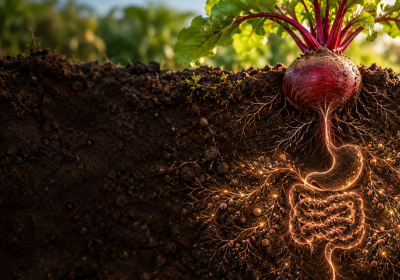

An apple isn’t what it used to be. Neither is a carrot, a head of broccoli, or a stalk of kale. And while we spend hundreds of billions of dollars managing the diseases that come from eating nutritionally hollow food, the upstream cause — the soil itself — is systematically being handed over to the same corporations that emptied it in the first place.
Listen to the audio version of this article:
THE TOPLINE
- Modern fruits and vegetables are nutritionally hollow compared to decades past, with documented declines of 50%+ in key minerals like iron and copper over 80 years — a direct consequence of industrial agriculture’s reliance on synthetic fertilizers and pesticides that degrade the soil microbiome responsible for cycling nutrients into plants.
- The resulting nutrient deficiencies are likely fueling the chronic disease epidemic: the same vitamins and minerals Americans are broadly deficient in (magnesium, vitamin D, A, C, and E) are closely linked to the diabetes, obesity, and cardiovascular conditions that now consume 86% of U.S. healthcare spending — yet the medical system responds with pharmaceuticals rather than addressing the upstream cause.
- A “green” biotech pivot by the same agrichemical giants — engineering soil microbes — poses serious risks, as these living organisms can mutate, spread, and permanently alter soil ecosystems we barely understand; regenerative agriculture offers a proven alternative that rebuilds soil health naturally, without the irreversible gamble of open-air genetic experimentation.
An 80-Year Wake-Up Call
In 2021, British researchers did something nobody had done before. They pulled the UK government’s Composition of Foods Tables — a meticulous national record of what’s actually inside the fruits and vegetables people living in Britain eat — and compared three editions: 1940, 1991, and 2019.
The results should have made the front page of every newspaper. Across 80 years, the average mineral content of common fruits and vegetables had collapsed. Sodium was down 52%. Iron, down 50%. Copper, down 49%. Magnesium, down 10%. Water content, meanwhile, had crept up. The researchers, publishing in the International Journal of Food Sciences and Nutrition, called for urgent investigation of the causes.
American analyses going back decades show calcium in common vegetables down by a quarter or more, vitamin C down roughly 30%, and vitamin A in many crops cut by a third to nearly two-thirds. By one estimate, you’d need to eat eight oranges today to get the vitamin A your grandparents got from one.
The sad truth is that our food supply has been slowly, quietly hollowed out — and the public health establishment is asleep at the wheel.
Sick People, Expensive Drugs, Depleted Food
Half of Americans have a chronic disease. They consume 86% of our healthcare dollars. Diabetes rates jumped eight-fold between 1958 and 2015. Obesity has tripled since the 1950s; 42% of US adults are now obese.
The standard response is to blame the patient and reach for a prescription pad: statins, metformin, GLP-1 agonists, blood pressure pills. We have built a healthcare system that excels at managing the downstream symptoms of metabolic dysfunction with expensive, often dangerous, often ineffective pharmaceuticals.
What we’ve largely ignored is the terrain. More than half of Americans don’t meet the government’s low benchmarks for magnesium. Nearly 95% fall short on vitamin D. Roughly 83% don’t get enough vitamin E; 43% are below the bar for vitamin A and nearly 40% don’t get enough vitamin C. These deficiencies are linked, in study after study, to the very chronic diseases we’re spending trillions to manage downstream.
Why the Food Got Hollow
The collapse in food quality tracks with the rise of industrial agriculture. Between 1950 and 1997, the number of US farms fell by 64.5% while average farm size more than doubled. Small, diversified operations were swallowed by sprawling monocultures of corn, wheat, and soy — the cheap commodity crops the federal government subsidizes precisely because they are the raw material for the ultra-processed foods that dominate the modern American diet.
Industrial farms don’t rotate crops. They lean on synthetic fertilizers and a torrent of pesticides — usage up 222% between 1960 and 1981. Chemical fertilizers push yield while ignoring the trace minerals plants need to build phytochemicals and human beings need to stay well. Pesticides damage the soil organisms responsible for cycling those minerals into plants in the first place.
The result is a treadmill: a new chemical kills weeds, weeds become resistant, soils go sterile, a more potent chemical is developed, more fertilizer is dumped on — and so on. Over half the world’s topsoil has been lost in the last 150 years. Soil takes at least 200 years to form a layer one centimeter deep.
A “Biological” Rebrand for the Same Old Extraction
Faced with diminishing returns from chemicals, the agrichemical industry is now pitching what it calls “biologicals” — genetically engineered (GE) soil microbes, bacteria altered in the lab and sprayed onto fields. The marketing is irresistible: “natural,” “green,” “regenerative.” The reality is anything but.
The global microbial products market is already worth $15 billion a year. Bayer, Syngenta, Corteva, BASF, and Ginkgo Bioworks are all racing for position.
Unlike a chemical, a microbe is alive. It reproduces, mutates, and can swap genetic material with other microbes through horizontal gene transfer — the same mechanism that drives antibiotic resistance. Once released into open soil, it cannot be recalled. A recent Friends of the Earth report called it “an unprecedented open-air experiment that may have irreversible consequences.”
And the experiment is being run on territory we barely understand. Of the billions of microbial species in soil, scientists have characterized less than 1%. The rhizosphere — the web of life around plant roots — is what makes nutrients available to crops, regulates the planet’s nitrogen and carbon cycles, and lets plants signal each other through fungal networks. It is, by many measures, the most valuable ecosystem on Earth, and we are now poised to introduce completely novel, genetically engineered microbes into this delicate environment.
The precedents should give anyone pause. GE mosquitoes released in Brazil to crash local populations may have produced hardier mosquitoes instead. CRISPR editing of human embryos to repair a single mutation appeared to “wreak genetic havoc” in about half the specimens examined. And here’s another inconvenient fact: extensive field testing across multiple states found GE soil microbes failed in most cases to even increase crop yields.
What Real Soil Health Looks Like
We are not actually stuck between a depleted chemical regime and an unregulated biotech one. A third path is well-developed and increasingly hard to ignore: regenerative agriculture.
A teaspoon of healthy soil contains more living organisms than there are human beings on the planet. Agronomist John Kempf distills the work of restoring that life into six principles: create the right physical environment for soil biology; restore the biology that has been lost through compost and microbial inoculants; feed it daily with mulch and cover crops; provide balanced mineral nutrition; use foliar sprays to maximize photosynthesis; and avoid the nutrient excesses that drive most pest and disease pressure. Plants raised this way climb what Kempf calls the Plant Health Pyramid — becoming both more nutritious for humans and increasingly resistant to pests on their own. The plant doesn’t need a chemical crutch because it has been allowed to develop functioning biology.
Do you sense a pattern? Healthy plants are better able to resist pests on their own, reducing the need for pesticides and other chemical inputs. Healthy people are no different. When we nourish the body with good food, regular exercise, and adequate sleep, we strengthen its natural capacity to maintain health and lessen our dependence on pharmaceutical interventions.
The award-winning documentary Planet Soil, championed internationally by ANH (and directed by the elder brother of ANH founder, Rob Verkerk), captures both the wonder of what is alive beneath our feet and the catastrophe of what is being lost. Healthy living soils hold vast reserves of water, reduce flooding, sequester carbon, and — together with sunlight and water — form the essential matrix for producing nutrient-dense food. Dead soils do none of these things.
The Pattern We Keep Falling For
Step back, and a pattern comes into focus. We don’t address upstream causes; we medicate downstream effects. We deplete the soil with chemicals, end up with food that doesn’t nourish, develop chronic diseases at epidemic rates, and then turn to the pharmaceutical industry. When the chemical model starts to falter, the same corporate constellation pivots to biotechnology.
The losers, every time, are ordinary Americans: sicker, more reliant on expensive prescriptions, and increasingly cut off from the farms that once knew how to produce truly nourishing food.
The winners are the same handful of agrichemical, biotech, and pharmaceutical giants.
What Needs to Happen
The chronic disease epidemic will not be solved at the pharmacy counter. It will be solved, if it is solved at all, by reckoning with the upstream conditions that created it — beginning with the few inches of living, breathing earth that everything else depends on.
We have spent eighty years finding out what happens when we treat soil as something to be exploited and food as a product to be optimized for shelf life. The data are in. The bill is coming due. And the next big technological “fix” being marketed to us is not a fix at all — it is the same story in a green wrapper.
It’s time to stop managing the symptoms and start healing the terrain.
If you care about real food, soil health and your own natural health, please share this article with your network.